
When Play Should Be Safe: Legal Perspectives on Playground Equipment
Playgrounds should be places where children build confidence, friendships, and motor skills, not emergency room visits. Safe playground equipment prevents childhood injuries when it is properly designed, installed, and maintained. When that safety net fails, families are often left facing medical bills, missed work, and long-term healing. Personal injury law steps in to ask an important question: could this accident have been prevented with reasonable care. Understanding that question can help parents both reduce risk and protect their rights if the unthinkable happens.
In many playground injury cases, the core legal issue is not that children play energetically, but that adults and organizations failed to provide a reasonably safe environment. Parks departments, schools, childcare centers, and property owners all have legal responsibilities tied to the playgrounds they control. Those responsibilities influence everything from the type of equipment chosen to how often bolts are tightened and surfaces are replaced. By viewing playground safety through a legal lens, parents and community advocates can push for safer equipment and stronger accountability before an injury ever occurs.
Safe Equipment Is More Than Good Design—It Is a Legal Obligation
When a school, city, or business invites children to use a playground, it is not just offering a fun amenity; it is taking on a legal duty. That duty generally requires providing equipment and surfaces that are reasonably safe for their intended age group. It also includes anticipating common childhood behavior such as running, climbing, and exploring in unpredictable ways. Courts often look at whether a responsible operator took known safety guidelines and common sense precautions seriously. If they cut corners, liability for preventable injuries may follow.
Safe playground equipment prevents childhood injuries by reducing foreseeable hazards that adults, not children, are expected to control. This includes choosing age-appropriate play structures, shock-absorbing surfaces, secure railings, and stable anchoring systems. It also means ensuring equipment is installed by qualified professionals following accepted safety practices. When owners or operators ignore these obligations, their choices can move from unfortunate to legally negligent. In that gap is where personal injury claims arise and where families can seek compensation for harm.
Key Features of Safe Playground Equipment That Reduce Injury Risk
From a legal standpoint, certain safety features show that an owner or operator took reasonable steps to prevent injury. Impact-absorbing ground coverings such as engineered wood fiber, rubber tiles, or poured-in-place rubber can significantly soften falls from swings and climbing structures. Guardrails and barriers on elevated platforms help prevent dangerous drop-offs. Covered bolts, rounded edges, and open sightlines reduce the risk of cuts, entrapment, and supervision gaps. Each of these design choices may become important evidence when evaluating whether a playground was kept reasonably safe.
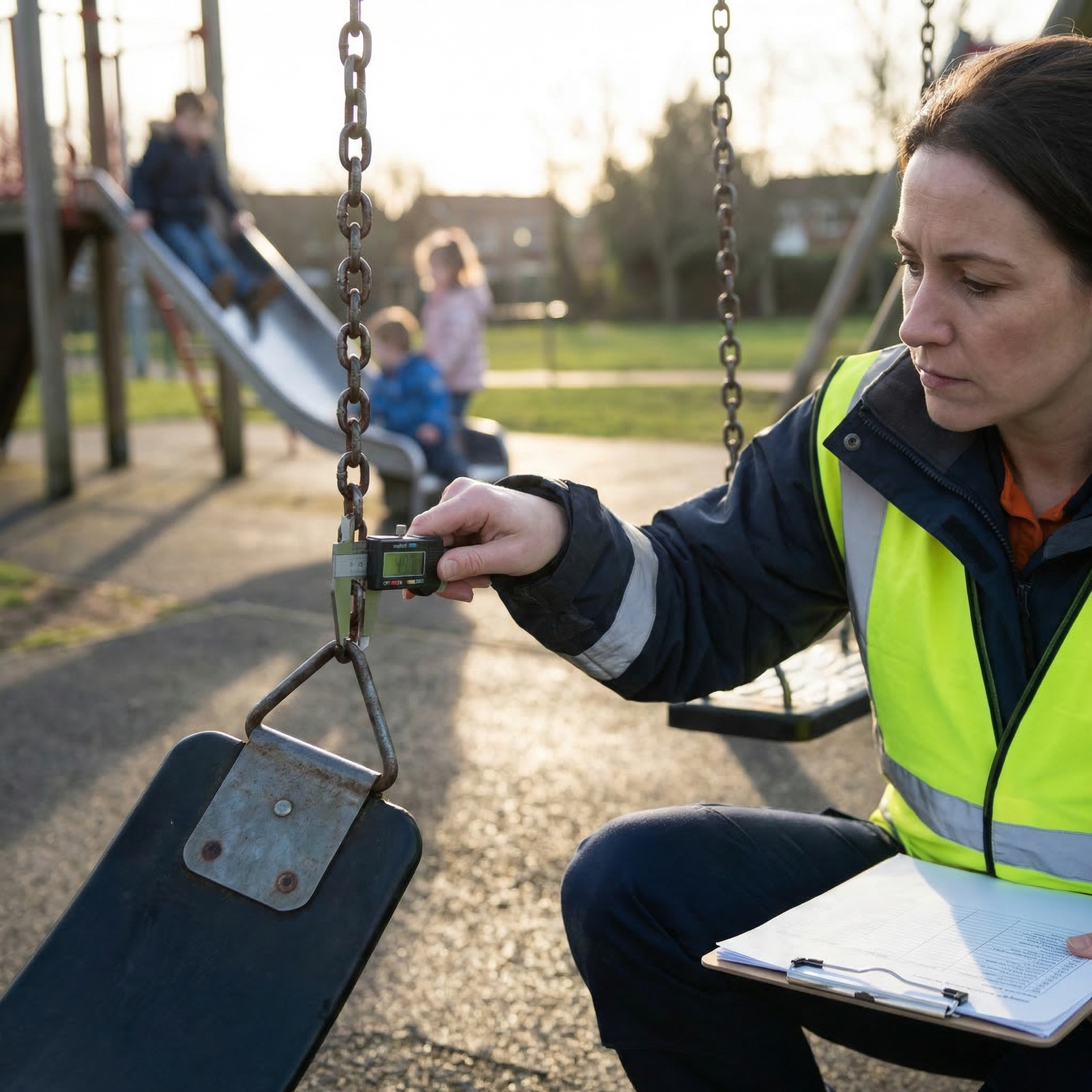
Parents and advocates can use a basic safety checklist during visits to playgrounds to spot red flags. Look for surfacing that is deep enough and well-maintained under and around climbing equipment, rather than packed-down dirt or exposed concrete. Check that swings are spaced apart with sufficient clearance, and that slides and ladders are stable with secure handholds. Note whether equipment appears modern, properly anchored, and free from obvious rust, cracks, or broken parts. These observations not only protect children in the moment but can also provide crucial details if an injury later leads to a legal claim.
Common Ways Playgrounds Become Legal Hazards
Most playground injuries do not occur because a child did something unusual; they happen when everyday play collides with preventable hazards. Worn or missing surfacing, loose hardware, and broken components can turn a normal fall into a serious fracture or head injury. Inadequate inspections may allow dangerous conditions to persist for weeks or months. Poor layout can send children running from one zone into the path of swings or moving equipment. Each of these failures can reflect a deeper pattern of neglect rather than a one-time oversight.
From a legal perspective, patterns matter. If a property owner receives complaints about equipment, sees visible wear, or skips recommended inspection schedules, their exposure to liability can increase. Faded warning signs or complete lack of age-appropriate labeling may also be used to show disregard for safety. In some cases, mixing equipment for toddlers with structures intended for older children can create a predictable hazard. When a child is injured in such an environment, a personal injury attorney will look closely at these systemic issues to determine whether negligence played a role.
Proving Negligence When Unsafe Equipment Causes a Child’s Injury
To pursue compensation after a playground accident, an injured child’s family generally must show that someone responsible for the property failed to act with reasonable care. That may involve comparing the playground to widely recognized safety guidelines, manufacturers’ instructions, or an organization’s own written policies. Photographs, maintenance logs, and witness statements can help establish what condition the equipment was in before and at the time of the injury. A lawyer may also consult with safety experts who can explain how proper design or upkeep could have prevented the harm. Together, this evidence builds a picture of what should have happened versus what actually did.
Safe playground equipment prevents childhood injuries only when it is both appropriate and properly maintained, so breakdowns in either area can support a negligence claim. For example, installing climbing equipment over hard concrete instead of cushioning material may be viewed as inherently unsafe. Likewise, leaving a broken guardrail unrepaired after prior reports may suggest disregard for known dangers. Proving these failures can open the door to recover medical expenses, therapy costs, and damages for pain, suffering, and potential long-term effects on the child’s development. The legal goal is not to punish play, but to hold adults accountable for avoidable risks.
Steps Parents Should Take Immediately After a Playground Accident
In the chaotic moments after a child is injured on a playground, health and safety come first, but legal protection can start early as well. Seek prompt medical care and describe clearly how the injury occurred, noting the equipment involved and whether a fall or impact was involved. If possible, take photos or short videos of the playground from multiple angles, including close-ups of any defects or hazardous conditions. Capture the condition of the surface, nearby signs, and any temporary fixes like tape or makeshift barriers. These images may be far more persuasive later than memories alone.
Parents should also gather basic information while details are still fresh. Write down the date, time, and weather conditions, and note whether any staff, teachers, or attendants were present. Ask for the names and contact information of witnesses who saw the incident or the unsafe condition beforehand. If the playground is associated with a school, daycare, or business, request a copy of any incident report and note who you speak with. As soon as practical, consider contacting a personal injury attorney who handles child injury claims, so important deadlines and evidence-preservation steps are not missed.
Working With a Personal Injury Lawyer to Protect Your Child’s Future
After a serious playground injury, families often face more than immediate medical bills; there may be follow-up surgery, physical or occupational therapy, and emotional impacts that unfold over time. A personal injury lawyer can help assess the full scope of these losses, including future care needs that may not yet be obvious. They will investigate who may be responsible, from public agencies and private schools to equipment manufacturers and installation contractors. Different parties may share responsibility if design, installation, and maintenance all played a role in the hazard. Identifying all potential sources of recovery can be crucial to securing adequate compensation.
Safe playground equipment prevents childhood injuries, but when safety systems fail, the legal process can help fund healing and encourage change. A lawyer can negotiate with insurance companies, obtain maintenance records through formal information requests, and consult experts who understand playground safety standards. They can also advise families about realistic timelines, possible settlement ranges, and the pros and cons of going to trial. Throughout the process, the focus remains on protecting the child’s well-being and future opportunities. By holding negligent parties accountable, families and advocates help push communities toward safer, better-managed places for every child to play.