
When a Bike Crash Story Is Not Enough
Bicycle crashes often happen in a few terrifying seconds, leaving riders with painful injuries and blurred memories about what went wrong. Drivers, insurers, and even witnesses may offer very different versions of the same collision, each pointing the finger somewhere else. When the stories conflict, the question becomes whose account the insurance company or a jury will believe and rely on when deciding compensation. Bicycle accident reconstruction steps into this gap, turning scattered evidence into a logical timeline of events. For injured cyclists, that scientific analysis can become the backbone of a strong personal injury claim and a fair outcome.
What Bicycle Accident Reconstruction Really Means in an Injury Case
Bicycle accident reconstruction is a specialized investigation that uses physics, engineering, and traffic safety principles to explain how a crash occurred. These experts analyze physical evidence, scene measurements, and available data to answer critical questions about speed, position, visibility, and reaction time. Their work is not just about technical diagrams; it directly addresses who had the right-of-way and whether each party followed the rules of the road. In a personal injury case, those conclusions help establish negligence, which is the legal foundation for fault and liability. Without reconstruction, an injured rider may be forced to rely on guesswork rather than credible, objective proof.
Reconstruction becomes especially important when the crash involves serious injuries, disputed police reports, or a deceased or unconscious cyclist. In these situations, the person most harmed may not be able to clearly explain what happened or respond to unfair accusations. A reconstruction expert can effectively “speak” for the cyclist by interpreting tire marks, vehicle damage, and other traces left behind. Their report can highlight where a driver failed to yield, drifted into a bike lane, or traveled at an unsafe speed. This independent analysis helps your legal team argue fault based on measurable facts rather than assumptions and bias.
Key Evidence Experts Examine at a Bicycle Crash Scene
Accident reconstruction starts with evidence, and what appears insignificant to a bystander may be crucial to an expert. They look at skid marks, gouges in the pavement, and debris patterns to estimate speeds and impact angles. The location of the bicycle, the vehicle, and any broken parts can reveal whether the cyclist was hit from behind, sideswiped, or cut off in a turn. Clothing damage, helmet cracks, and even the pattern of injuries on the rider’s body may support conclusions about how and where the impact occurred. Together, these details form a physical narrative that either supports or contradicts what people claim to remember.
Beyond the roadway itself, modern reconstruction also draws on digital and documentary evidence whenever it is available. Experts may review dashcam videos, business security footage, and data from vehicle event recorders if they exist and can be obtained. They compare these materials to police diagrams, 911 call timing, and weather reports to check for consistency and discover overlooked details. Photographs taken by the cyclist, witnesses, or first responders are carefully measured and analyzed to recover information that might otherwise be lost. When all of these sources are evaluated together, they give a far more complete picture than a single traffic citation or brief incident report can provide.
Connecting Reconstruction Findings to Legal Fault and Liability
In a personal injury lawsuit, it is not enough to show that a crash happened; you must show that someone’s careless conduct caused it. Bicycle accident reconstruction helps answer that legal question by linking specific driver or cyclist actions to the physical evidence. For example, measurements of skid marks and stopping distances can show that a driver was following too closely before striking a rider. Sight-line analysis can demonstrate that a cyclist was visible in a marked bike lane when a vehicle suddenly turned across their path. Each of these findings supports an argument that the driver breached a duty of care and should be held financially responsible.
Reconstruction also helps quantify how much of the blame, if any, might be assigned to the cyclist under comparative negligence rules. An expert can evaluate whether the rider’s position in the lane, lighting, or signaling affected the outcome, and separate speculation from reality. When insurers attempt to reduce payouts by claiming the cyclist “came out of nowhere,” reconstruction can show that this was physically impossible. By clarifying the relative fault of everyone involved, your attorney can more accurately value the claim and push back against unfair reductions. This clarity often leads insurers to reconsider low settlement offers once they understand the strength of the technical evidence.
Challenging Anti-Cyclist Myths with Scientific Analysis
Cyclists frequently encounter bias in the aftermath of a crash, with assumptions that they ignored traffic laws or took unreasonable risks. Bicycle accident reconstruction helps dismantle those stereotypes by grounding the discussion in measurable facts rather than opinions. An expert can verify whether the cyclist stopped at a light, traveled within a designated lane, or used proper lighting after dark. They can also test competing versions of events to see which are physically consistent and which are not supported by the evidence. When jurors and adjusters see objective analysis, it becomes harder to blame the cyclist simply because they were more vulnerable.
This scientific perspective is especially powerful when the driver’s account has changed over time or conflicts with physical realities at the scene. If a motorist insists the cyclist was speeding, for example, reconstruction can compare that claim against stopping distances and impact damage. When a driver says they could not see the rider, the expert can evaluate sight lines, headlight reach, and obstruction angles. Demonstrating that the cyclist was both visible and operating predictably can significantly shift perceptions about who acted reasonably. As a result, reconstruction not only supports legal arguments, it can also correct harmful narratives that might otherwise undermine an injured rider’s credibility.
Modern Tools That Support Bicycle Accident Reconstruction
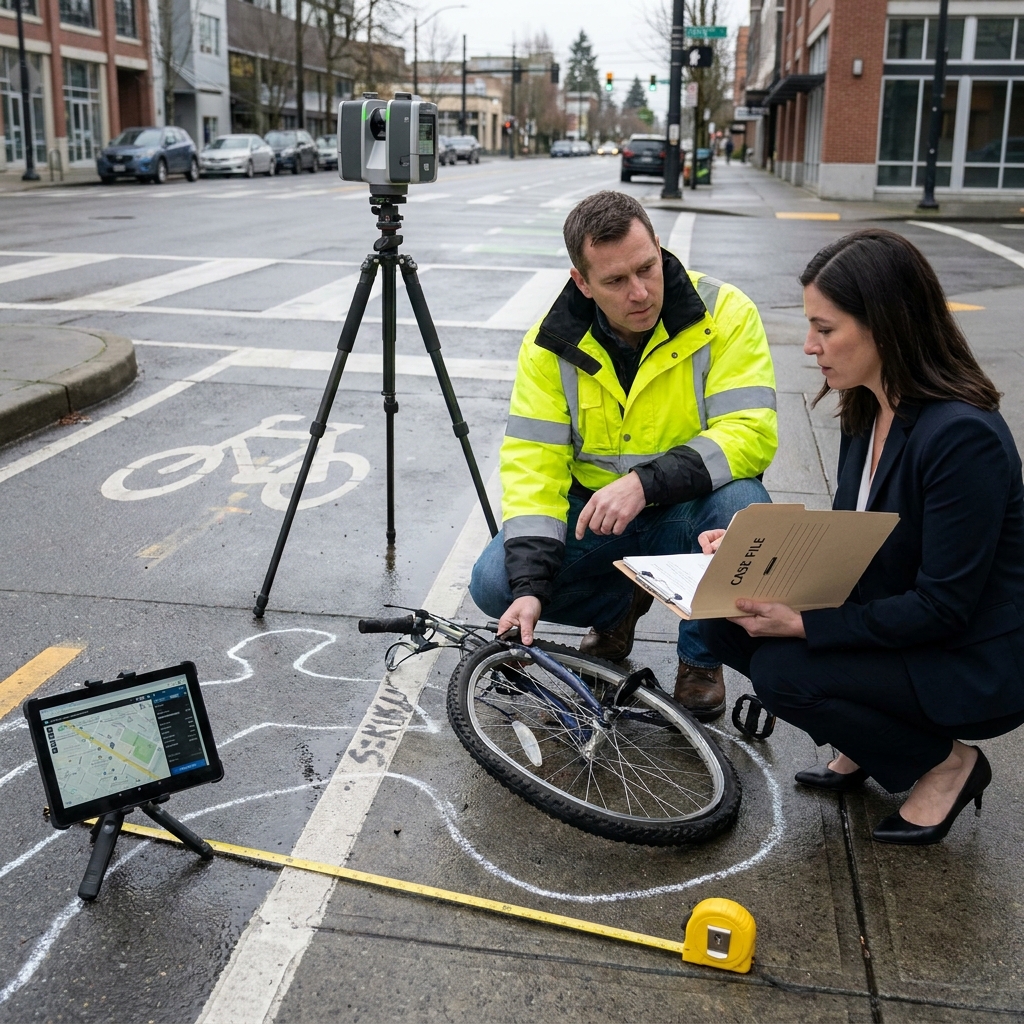
Today’s reconstruction experts increasingly use digital tools to supplement traditional scene measurements and photographs. Laser scanners and advanced surveying equipment can capture precise three-dimensional models of intersections, road gradients, and curb structures. Software programs then allow experts to simulate movements of the bicycle and vehicle based on known speeds, distances, and reaction times. These visualizations help judges, juries, and insurers clearly see how a collision unfolded in a way words alone cannot achieve. For seriously injured cyclists, those visuals can be especially persuasive in demonstrating the violence of the impact and the lack of time to avoid it.
Technology also helps preserve evidence that might otherwise disappear long before a case reaches trial or settlement discussions. High-resolution scene mapping allows experts to revisit the crash virtually even after skid marks fade and construction changes the roadway. Data from connected devices, when available, may also be examined within proper legal and privacy limits. Your legal team works with reconstruction professionals to identify and secure this information as early as possible. By combining advanced technology with seasoned judgment, they can present a clearer, more compelling explanation of fault and liability on your behalf.
Steps Injured Cyclists Can Take to Protect Reconstruction Evidence
While accident reconstruction depends heavily on professional expertise, injured cyclists and their families can play an important role in preserving critical information. If it is safe and medically possible, photographs of vehicle positions, skid marks, traffic signals, and road hazards should be taken immediately. Contact information for witnesses can be gathered before people leave and their memories begin to fade. The damaged bicycle, helmet, and clothing should be kept in their post-crash condition rather than repaired or discarded. Sharing this preserved evidence quickly with a personal injury attorney allows them to engage a reconstruction expert before important details are lost.
Even when you cannot document the scene yourself because of injuries, there are still important protective steps to consider later. Avoid giving detailed statements to insurance adjusters before speaking with counsel, because early speculation can conflict with later expert findings. Do not apologize or accept blame simply because you feel shaken or confused about the sequence of events. Instead, focus on medical care, keep copies of all reports, and provide your lawyer with every photograph, message, or document connected to the crash. With timely legal guidance and a thorough reconstruction, you greatly increase the chances that fault and liability will be assigned based on truth, not assumptions.