

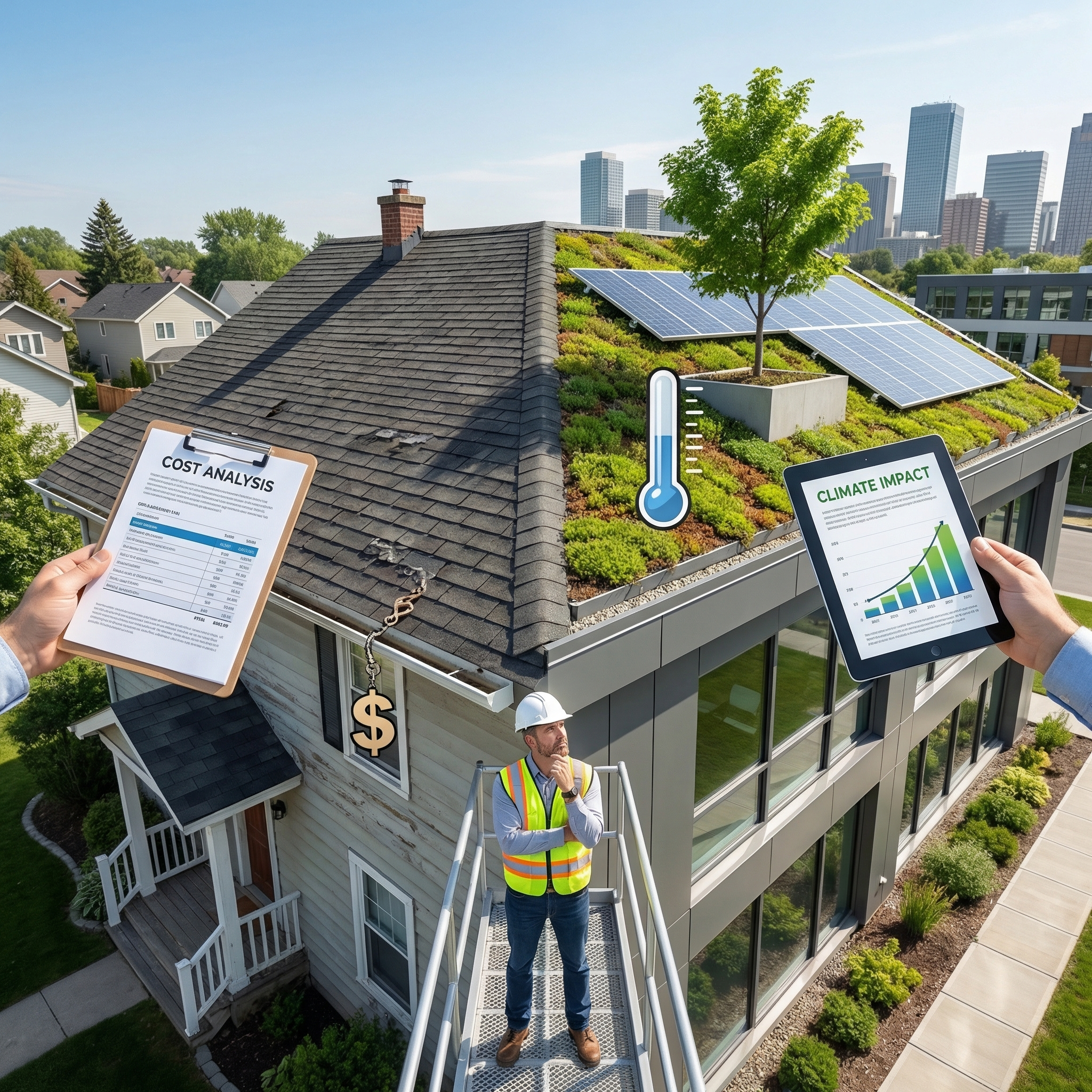
Looking Beyond Sticker Price on Modern Roof Choices
When property owners compare roofing options, the first number they see is the proposal total, but that figure rarely tells the whole story. Traditional roofing systems may be cheaper to install, yet they can carry hidden long-term expenses in maintenance, tear-offs, and higher energy bills. Innovative systems often demand more capital upfront but may pay it back through longer life, lower utilities, and environmental benefits. Both residential and commercial projects need to weigh these financial realities alongside their climate and sustainability goals. A balanced decision looks at what the roof costs today, what it costs to own, and what it costs the planet.
Contractors, facility managers, and homeowners all approach this trade-off from slightly different angles, yet the core questions remain the same. Which system aligns with the budget limits and performance expectations for the building? How will the roof interact with local climate, codes, and utility rates over the next few decades? What environmental impacts are created when you install, maintain, and eventually replace the system? By organizing those questions, buyers can compare traditional and innovative roofs in a transparent, apples-to-apples way.
Traditional Versus Innovative Roofing in Practical Terms
In residential work, traditional roofing usually means asphalt shingles or basic metal panels, while commercial projects lean on built-up roofing and single-ply membranes. These systems are familiar to contractors, widely stocked, and supported by established details and installation practices. Innovative roofing includes technologies like cool roof membranes or coatings, high-performance standing seam metal, vegetative roofs, and integrated solar roofing. Many of these systems aim to improve energy efficiency, extend service life, or add functionalities such as stormwater management. The trade-off is that they can be more complex to design and install correctly.
From a financial standpoint, traditional roofs benefit from economies of scale and a large installer base, which generally keeps bid prices competitive. They may, however, require more frequent replacement, creating higher lifecycle costs and more material going to landfill. Innovative roofs can reduce those long-term costs but may involve extra engineering, specialty crews, or manufacturer inspections. Environmentally, traditional materials like asphalt shingles and some membranes are harder to recycle and often have higher waste volumes. Innovative systems more often focus on recyclability, reduced heat gain, and longer service life to reduce their overall footprint.
- Traditional systems: familiar, lower upfront cost, shorter average lifespan.
- Innovative systems: higher upfront cost, performance-driven, potentially longer lifespan.
- Both types must be evaluated against project-specific climate and use patterns.
Upfront Investment Versus Lifecycle Cost
Budget conversations usually start with the installed cost per square foot, but stopping there can skew decisions toward short-term savings. A low bid on a traditional system may look attractive until you factor in the cost of future tear-offs and the disruption they bring to homes or businesses. Innovative roofs, especially metal, cool membranes, or hybrid systems, can shift the financial picture by lasting longer and needing fewer major repairs. When owners hold properties for decades, those avoided replacements and leak calls can outweigh the initial premium. Even for shorter hold periods, a documented lifecycle cost can support resale value and financing discussions.
To compare systems fairly, decision-makers should estimate not only installation but also maintenance, repair, and replacement timelines. That means asking manufacturers for realistic service-life ranges, not just warranty terms. It also means modeling local labor rates and disposal fees for future tear-offs, which can be significant in urban commercial markets. Innovative systems may require slightly higher routine inspection costs, yet they often avoid large unplanned repairs by catching issues early. A simple lifecycle cost analysis can turn a seemingly expensive innovative roof into the more economical choice over a 20- to 30-year window.
- Include labor, materials, permits, and disposal in cost comparisons.
- Estimate at least one full replacement for shorter-life traditional options.
- Consider resale value and buyer appeal of long-life, energy-efficient roofs.
Energy Performance and Operational Savings
Roofing plays a central role in a building’s energy profile, especially in hot or mixed climates where cooling loads dominate. Traditional dark roofs tend to absorb more solar heat, which can drive up air conditioning use in homes and commercial spaces. Innovative systems like cool roofs, reflective coatings, and well-insulated assemblies are engineered to limit heat gain. Over time, those energy savings can meaningfully offset the initial investment, particularly on large commercial roofs with extended cooling seasons. Residential owners may notice improved comfort as well as smaller utility bills, especially in top-floor rooms or attic spaces.
When assessing options, it helps to look at how reflectivity, emissivity, and insulation levels change the building’s overall energy balance. On commercial facilities, owners and energy consultants can model projected kWh savings to compare different membranes or coatings. Residential clients may rely more on utility bill history and contractor experience in the local climate zone. Innovative roofs that integrate solar photovoltaic panels further change the equation by generating electricity instead of only reducing demand. While not every project can host solar, roofs designed with future solar-ready capacity protect options as codes and incentives evolve.
- Cool roofs lower surface temperatures and reduce cooling loads.
- Improved insulation in roof assemblies cuts both heating and cooling demand.
- Solar-ready or solar-integrated roofs can add an energy revenue stream.
Materials, Waste, and Environmental Footprint
The environmental trade-offs of roofing start with raw materials and extend through manufacturing, transport, installation, and ultimate disposal. Traditional asphalt shingles and some commercial membranes rely on petroleum-based components and often end up in landfills at the end of life. Innovative systems may use metal, high-durability synthetics, or layered assemblies designed for partial replacement instead of full tear-off. Metal roofing, for example, often contains recycled content and can be recycled again when removed, reducing waste volumes. Vegetative roofs introduce plants and growing media, which can improve local air quality and help manage stormwater runoff.
Tear-off cycles are a major driver of waste, especially on large flat commercial roofs. Shorter-lived traditional systems create more frequent disposal events, each involving demolition, hauling, and tipping fees at local facilities. Innovative approaches like recover systems, overlay designs, and long-life membranes aim to slow that cycle. Environmental benefits include reduced landfill use, less frequent manufacturing demand, and fewer truck trips associated with replacement. Project teams that track these impacts can present a stronger sustainability case to building owners, tenants, and community stakeholders.
- Longer service life generally means less cumulative material waste.
- Recyclable metals and modular systems improve end-of-life outcomes.
- Green roofs support stormwater control and urban heat island mitigation.
Risk, Resilience, and Insurance Considerations
Financial and environmental performance both depend on how a roof stands up to real-world weather and aging. Traditional systems have decades of track record, which can make their failure modes more predictable and easier to insure. However, some may be more vulnerable to wind uplift, hail impact, or UV degradation depending on the region and installation quality. Innovative roofs often target higher resilience with upgraded fastening, impact resistance, or fire performance. In severe weather markets, these advantages can translate into fewer emergency repairs, less interior damage, and more stable insurance relationships.
Insurers increasingly look at roofing materials and details when pricing policies for homes and commercial properties. Impact-resistant shingles, robust metal systems, and well-detailed commercial membranes may qualify for premium credits in some areas. At the same time, more complex systems like vegetative roofs or integrated solar can trigger additional underwriting questions. Clear documentation of design, installation, and maintenance plans helps address those concerns and protect coverage. From an environmental perspective, resilient roofs reduce the likelihood of premature failure, limiting unplanned waste and reconstruction emissions.
- Match roof assemblies to local wind, hail, snow, and fire risks.
- Confirm insurer requirements for innovative or atypical systems.
- Prioritize details that prevent small leaks from becoming large losses.
Aligning Roof Selection With Project Goals
No single roofing system is right for every residential or commercial project, which makes clarity around goals essential. Owners focused on the lowest initial cost may gravitate toward traditional systems, accepting shorter life and higher long-term waste. Sustainability-driven projects, high-occupancy facilities, and owner-occupied properties often find better value in innovative, high-performance roofs. Mixed-use buildings or portfolios may blend approaches, using traditional solutions on lower-priority structures and innovative systems where returns are strongest. The key is to align each roof with the building’s function, expected hold period, and environmental commitments.
Contractors and consultants can guide these choices by presenting clear trade-off scenarios rather than a single preferred product. Showing side-by-side comparisons of lifecycle cost, anticipated energy savings, and environmental impacts builds trust and supports smarter investments. On commercial portfolios, standardized evaluation criteria help compare projects across regions and building types. Residential clients may respond better to practical examples, such as fewer replacements over the life of a mortgage or cooler attic temperatures in summer. In every case, transparent reasoning turns the roof from a commodity purchase into a strategic asset.
- Define budget, hold period, and sustainability goals before choosing systems.
- Use comparable assumptions when contrasting traditional and innovative roofs.
- Document reasoning to support future resale, audits, or capital planning.
Action Checklist for Financial and Environmental Roofing Decisions
A structured checklist keeps roofing conversations focused and repeatable across projects and portfolios. Start by listing at least two traditional and two innovative options that are viable for the building type and local code. For each, estimate installed cost, expected service life, maintenance needs, and likely replacement schedule. Then, layer in energy performance, potential utility savings, and any solar or future upgrade compatibility. Finish with an environmental snapshot that includes material sourcing, recyclability, waste volume, and any stormwater or heat island benefits.
Once this information is assembled, rating each option on financial and environmental scales helps clarify trade-offs for owners. Some projects will prioritize rapid payback, while others place higher value on longevity, resilience, or sustainability certifications. Residential roofs might favor solutions that align with homeowner cash flow and comfort expectations. Commercial and institutional projects can afford to model more complex outcomes, including tenant satisfaction and brand impact from green building strategies. With a consistent process, teams can choose between traditional and innovative roofing systems with confidence instead of guesswork.
- Gather cost, performance, and environmental data for each realistic option.
- Score systems on lifecycle cost, risk, and sustainability, not just price.
- Document decisions to inform maintenance planning and future re-roofing cycles.